The Evidence Gap for Agentic AI Governance
The EU AI Act (Regulation 2024/1689) places strict obligations on high-risk AI systems. But autonomous agents present a unique challenge: they make consequential decisions and take real actions without continuous human supervision. Traditional logging and documentation practices were designed for passive prediction systems, not for agents that modify files, send emails, or trigger financial transactions.
This article maps the EU AI Act's three technically demanding governance themes - transparency, human oversight, and quality management - to a concrete evidence architecture for autonomous AI teams. We show how VEX Protocol's Evidence Capsules can support compliance workflows without claiming to replace legal review, certification, or deployment-specific obligations.
Article 13: Transparency and Provision of Information
The requirement: High-risk AI systems must produce outputs that are interpretable by users and deployers. Users must be informed they are interacting with an AI system, and the system must provide “clear and meaningful information” about its capabilities and limitations.
The agentic challenge: An autonomous agent may take dozens of tool calls to complete a task. A single “success” response tells you nothing about what files were read, what APIs were called, or what parameters were passed. Transparency requires per-action attribution, not just task-level summaries.
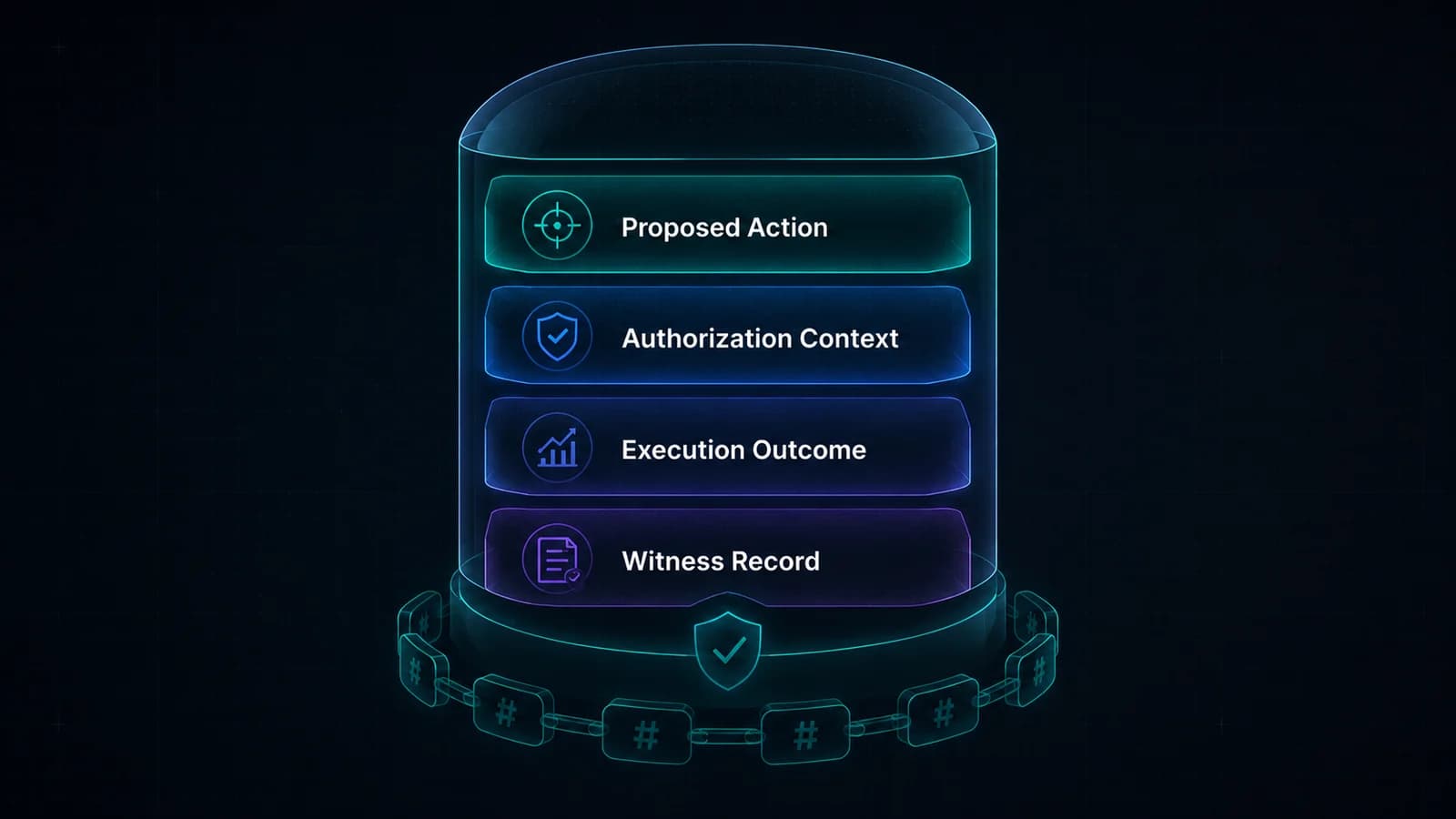
The evidence architecture: Selected governed actions can produce an Evidence Capsule containing:
Article 14: Human Oversight
The requirement: High-risk AI systems must be designed to allow human operators to “intervene, override, or stop operation at any time.” Oversight must be technically enforceable - not just documented in a policy manual.
The agentic challenge: An agent with unconditional tool authority cannot be overridden in practice. By the time a human reviews the action, the file has been deleted, the email sent, or the database modified. Post-hoc review is not oversight; it is incident response.
The evidence architecture: VEX Protocol is designed to support execution boundary governance:
This is more than conventional logging. It is a governance design pattern at the execution boundary - one important place where human oversight can become technically enforceable for autonomous systems.
Article 17: Quality Management System
The requirement: Providers must implement a quality management system covering risk management, data governance, technical documentation, and post-market monitoring. Records must be complete, accurate, and available for regulatory inspection.
The agentic challenge: Traditional audit trails can be modified, deleted, or truncated. A quality management system built on mutable logs cannot satisfy the integrity requirements of Article 17 - especially when the agent itself has write access to the log storage.
The evidence architecture: Cryptographic commitment can make later modification detectable when implemented:
Merkle-chain integrity
Where the VEX evidence layer is deployed with Merkle linking, modifying historical capsule data becomes cryptographically detectable during verification.
Merkle Audit Trail - ProvnAI Glossary
Separation of duties
A higher-assurance deployment can separate evidence production from the agent runtime so the agent does not control its own review record.
TEE Isolation - ProvnAI Glossary
Temporal attestation
A deployed evidence workflow can attach trusted timestamps to support review of event ordering; the implementation determines the assurance available.
Witness Log - ProvnAI Glossary
One Architecture, Multiple Frameworks
The same evidence architecture that supports EU AI Act Articles 13, 14, and 17 governance workflows can also support:
ICT risk management and incident reporting - Evidence Capsules can provide structured, attributable incident records.
System availability and processing integrity - tamper-evident evidence can support auditor review of control effectiveness.
Cybersecurity risk management - execution boundary governance maps to 'appropriate technical measures' for critical entities.
AI risk assessment and treatment - Evidence Capsules can provide objective evidence of AI system behavior and controls.
Implementation: From Theory to Production
Teams do not need to rebuild their agent infrastructure to implement evidence-based governance. VEX Protocol integrates at the execution boundary - the narrowest possible integration point:
Design governance evidence from the execution layer.
See how VEX Protocol can support EU AI Act, DORA, and SOC 2 governance workflows with a single evidence architecture.
Why MCP Security Needs Layered Runtime Enforcement
Historical v2.1.0 release analysis: preflight normalization, deterministic blocking, camouflage detection, semantic scoring as an advisor, behavioral signals, and explicit policy composition.
What Is an MCP Security Proxy? Prompt Injection Defense
What an MCP security proxy is, how it inspects routed tool calls, and where deterministic policy can reduce prompt-injection impact before execution.
MCP Security in Production: A 2026 Practical Guide
A layer-by-layer guide to securing MCP deployments in production - full attack surface, five-layer defense architecture, and a 10-point readiness checklist.
EU AI Act for Agentic AI: Technical Compliance Requirements
How the EU AI Act applies to autonomous agents. High-risk classification triggers, Articles 13/14/17, and the evidence architecture that supports them.