EU AI Act for Agentic AI:
Technical Compliance Requirements
“The EU AI Act does not regulate models. It regulates systems — and autonomous agents that take consequential action are squarely in scope.”
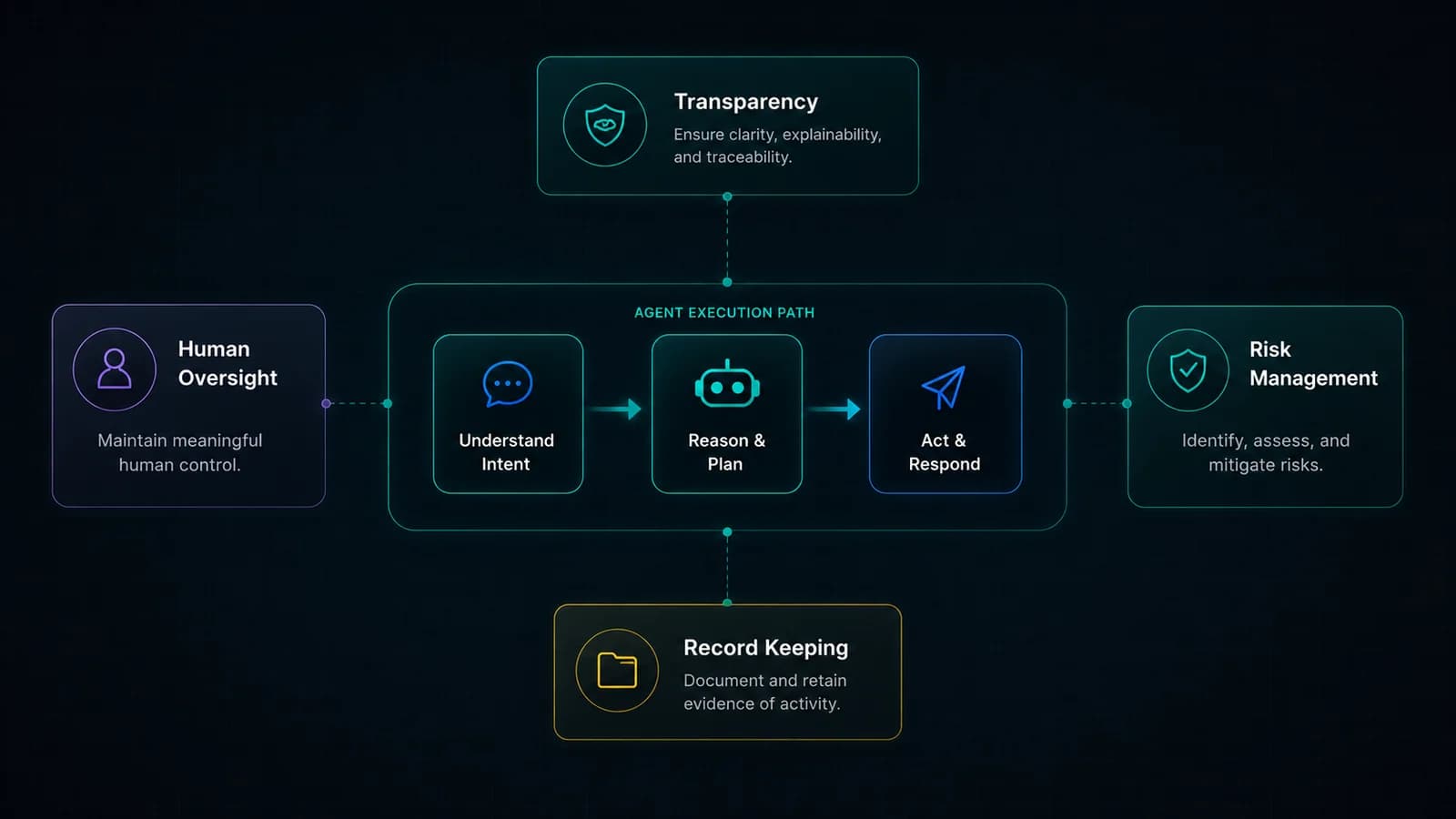
Why Agentic AI Is in the EU AI Act's Crosshairs
The EU AI Act (Regulation 2024/1689), in force from August 2024 with phased application through 2027, takes a risk-based approach. It does not ban AI. It places technical and governance obligations on AI systems that operate in high-risk contexts — and it defines those contexts broadly enough to capture most autonomous agent deployments.
A key principle: the Act regulates the system, not the model. An agent that wraps GPT-4o with MCP tool access to HR systems, financial databases, or critical infrastructure is a regulated AI system regardless of which underlying model it uses.
High-Risk Classification Triggers
Annex III of the Act lists eight high-risk categories. Autonomous agents commonly intersect with:
If your agent operates in any of these categories and is deployed to EU users or by EU-based organizations, the high-risk obligations apply — regardless of where the system is hosted.
Key Technical Requirements
High-risk AI systems must satisfy requirements under Articles 9–17. The four most technically demanding for agentic deployments:
Transparency and provision of information
Requirement: Users must be informed they are interacting with an AI system. The system must produce outputs that are interpretable by users and deployers.
Implementation: Every real agent action must be attributable and explainable. Tool calls should produce structured, reviewable records — not just an action and an outcome.
Human oversight
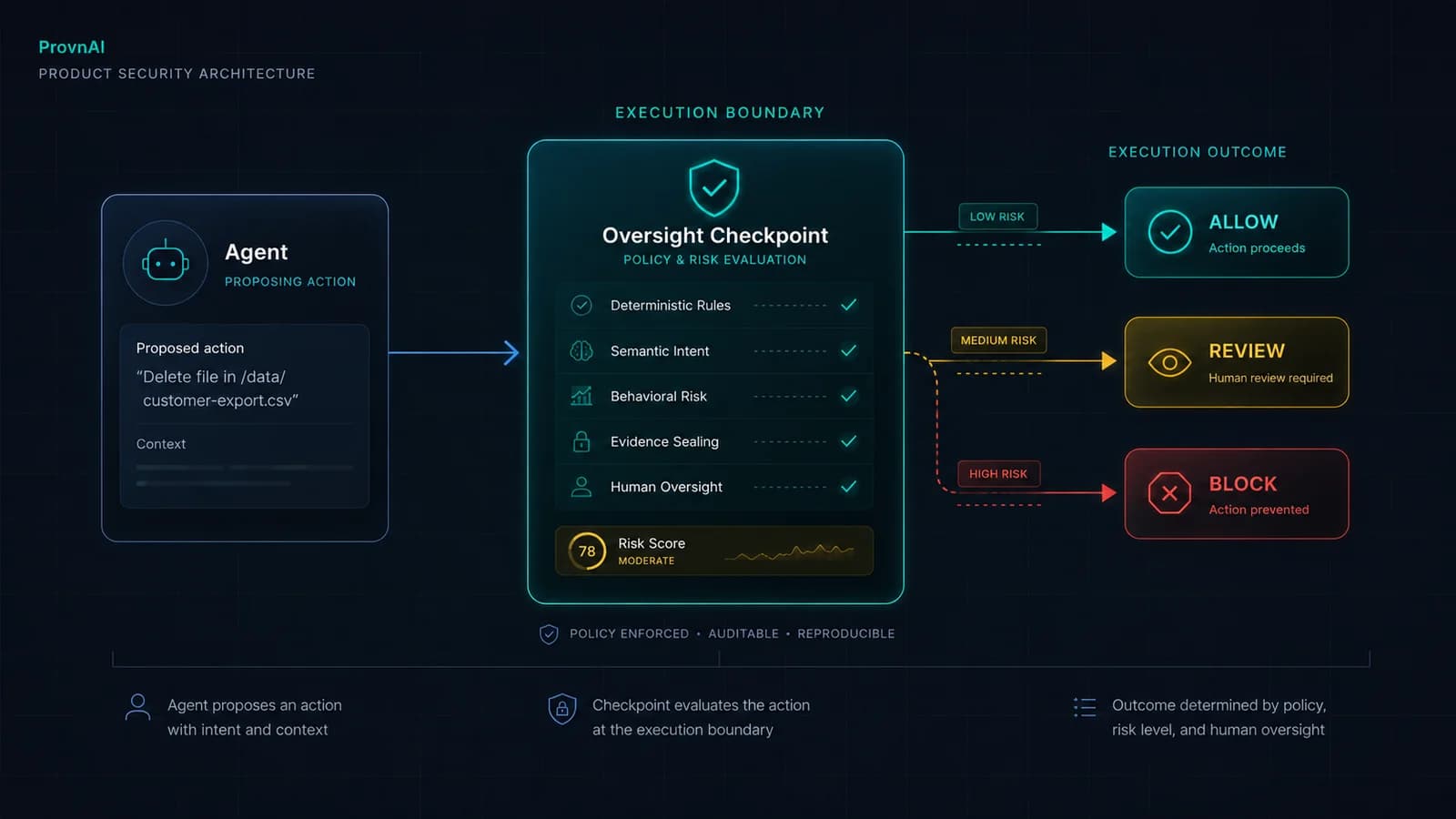
Requirement: High-risk AI systems must be designed to allow human operators to intervene, override, or stop operation at any time. Oversight must be technically enforceable — not just a policy.
Implementation: Agents cannot be given unconditional tool authority. Every action that matters must be capable of interception before execution. An approved/blocked/escalated gate at the execution boundary supports this requirement.
Quality management system
Requirement: Providers must implement a quality management system covering risk management, data governance, technical documentation, and post-market monitoring.
Implementation: Audit trails should be complete, appropriately protected, and retained. Cryptographic commitment can support the integrity and reviewability goals of Article 17 when the deployment implements it.
Risk management system
Requirement: A continuous, iterative risk management process must identify, analyze, and mitigate risks across the AI system lifecycle.
Implementation: Threat modeling of agent tool access surfaces (prompt injection, SSRF, privilege escalation) should be documented and reviewed regularly as part of the risk management record.
The Evidence Architecture That Supports All Three
Articles 13, 14, and 17 point toward an infrastructure requirement: the system should be capable of producing an accurate, reviewable record of what selected governed actions proposed, what crossed the boundary, and why.
This is what the VEX Protocol's Evidence Capsule architecture is designed to produce. Each capsule preserves governance context across authority, intent, identity, and witness — producing a record that supports the transparency, oversight, and audit requirements simultaneously.
For teams operating under DORA, SOC 2, or the NIS2 Directive alongside the AI Act, the same evidence architecture serves multiple compliance frameworks without duplicated instrumentation.
Design for compliance from the execution layer.
See how ProvnAI architecture maps to EU AI Act, DORA, and SOC 2 requirements.
Why MCP Security Needs Layered Runtime Enforcement
Historical v2.1.0 release analysis: preflight normalization, deterministic blocking, camouflage detection, semantic scoring as an advisor, behavioral signals, and explicit policy composition.
EU AI Act Evidence Architecture for Autonomous Agents
Articles 13, 14, and 17 mapped to technical evidence architecture for autonomous AI governance workflows.
What Is an MCP Security Proxy? Prompt Injection Defense
What an MCP security proxy is, how it inspects routed tool calls, and where deterministic policy can reduce prompt-injection impact before execution.
MCP Security in Production: A 2026 Practical Guide
A layer-by-layer guide to securing MCP deployments in production - full attack surface, five-layer defense architecture, and a 10-point readiness checklist.