
Why MCP Security Is Critical in 2026
The Model Context Protocol (MCP) has become the dominant standard for connecting AI agents to external tools and data — supported by Anthropic, OpenAI, Google, and Microsoft. By mid-2026, public security reporting described large numbers of MCP server instances directly exposed to the internet and a small number of high-severity (CVSS 9.x) vulnerabilities in production deployments — figures that vary by source and are difficult to verify independently.
The core problem is architectural. MCP was designed for capability, not for defense. It exposes a rich surface of tool calls — filesystem access, API calls, database queries, shell execution — that an AI agent can invoke on the basis of text instructions alone. When those instructions can be manipulated, the consequences are not theoretical.
The MCP Attack Surface
Every MCP deployment has the same four primary attack vectors. Understanding them is the prerequisite for defending against them.
Adversarial instructions embedded in user input, tool outputs, or retrieved documents override the agent's intended behavior and cause it to invoke unauthorized tools or exfiltrate data.
Agents with web-fetch or HTTP tools can be instructed to target internal cloud metadata endpoints (169.254.169.254), private network ranges, or internal services via crafted URLs.
Filesystem tools that accept relative paths can be exploited with sequences like ../../etc/passwd to read files outside the intended working directory.
Poisoned context — via RAG retrieval, memory injection, or malicious MCP server responses — redirects the agent to invoke tools with attacker-controlled arguments.
For deeper technical analysis of each vector, see the prompt injection research article and the AI Security Glossary.
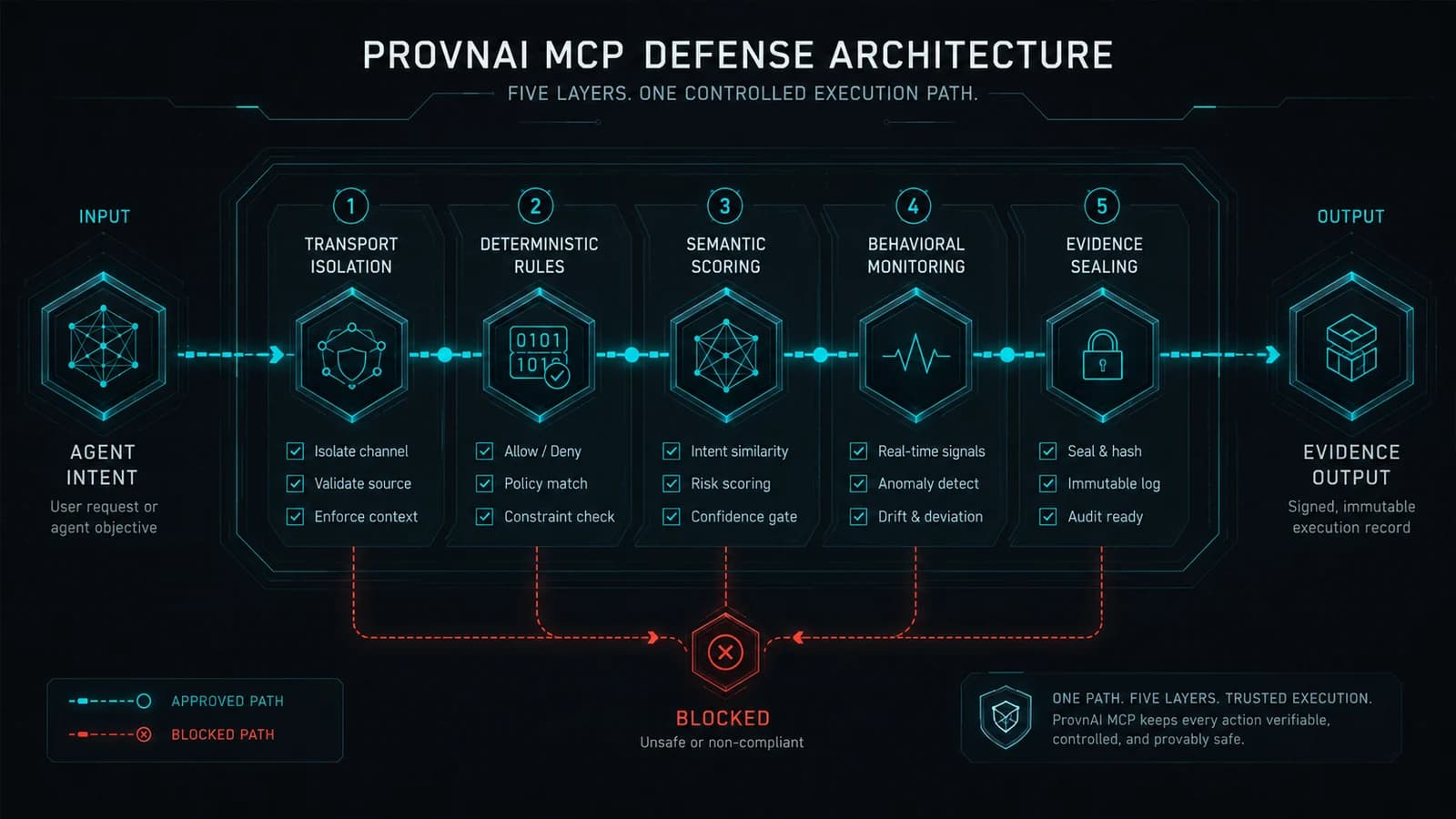
A Five-Layer Defense Architecture
Effective MCP security cannot rely on a single control. The NIST AI Risk Management Framework AI RMF 1.0 recommends defense-in-depth for AI systems — multiple independent controls that each reduce risk independently but compound together.
Transport Isolation
MCP servers should never be directly reachable from the internet. Place them behind an authenticated proxy. Enforce mTLS between agent runtime and MCP server. Restrict network ingress to named principals only.
Deterministic Rule Enforcement
A rules engine at the proxy layer evaluates routed tool calls before execution. Allowlists for permitted tool names and schemas. Pattern matching for known attack signatures (traversal sequences, metadata IPs, exfil patterns). Binary block/allow with no model inference involved.
Semantic Intent Scoring
Rules catch known patterns. When enabled, semantic scoring can evaluate routed tool-call arguments against configured context and policy signals. A file-read tool called with a path outside the stated working directory may surface an anomaly signal, even if no rule explicitly covers it.
Behavioral Monitoring
Track tool call frequency, argument variance, and sequence patterns per session. A legitimate agent working on a code task does not call a web-fetch tool 40 times in 90 seconds. Rate limits and behavioral anomaly detection catch exfiltration and misuse that rules miss.
Audit and Evidence
Routed permitted and denied tool calls should emit structured audit events. Higher-assurance deployments can preserve selected governed actions with tamper-evident evidence for incident reconstruction and compliance workflows.
McpVanguard packages deterministic enforcement with optional semantic and behavioral controls in a form that can be added to existing MCP deployments without changing server implementations.
Production Readiness Checklist
Before deploying any MCP-connected agent to production, verify the following controls are in place:
Implement this in your stack today.
McpVanguard is an open-source security proxy for MCP designed to be introduced into existing deployments with minimal friction.
What Is an MCP Security Proxy? Prompt Injection Defense
What an MCP security proxy is, how it inspects routed tool calls, and where deterministic policy can reduce prompt-injection impact before execution.
Why MCP Security Needs Layered Runtime Enforcement
Historical v2.1.0 release analysis: preflight normalization, deterministic blocking, camouflage detection, semantic scoring as an advisor, behavioral signals, and explicit policy composition.
MCP Prompt Injection & Tool Poisoning Defenses
How direct and indirect prompt injection reaches MCP tool calls through user input, RAG, and tool results, plus defenses with deterministic policy.
McpVanguard MCP Security Proxy
Open-source MCP security proxy for inspecting tool calls, enforcing policy, and blocking risky actions before execution.