Deterministic MCP Proxy: Policy Enforcement Outside the Model
How policy is enforced outside the model at the MCP boundary - with predictable, auditable behavior.
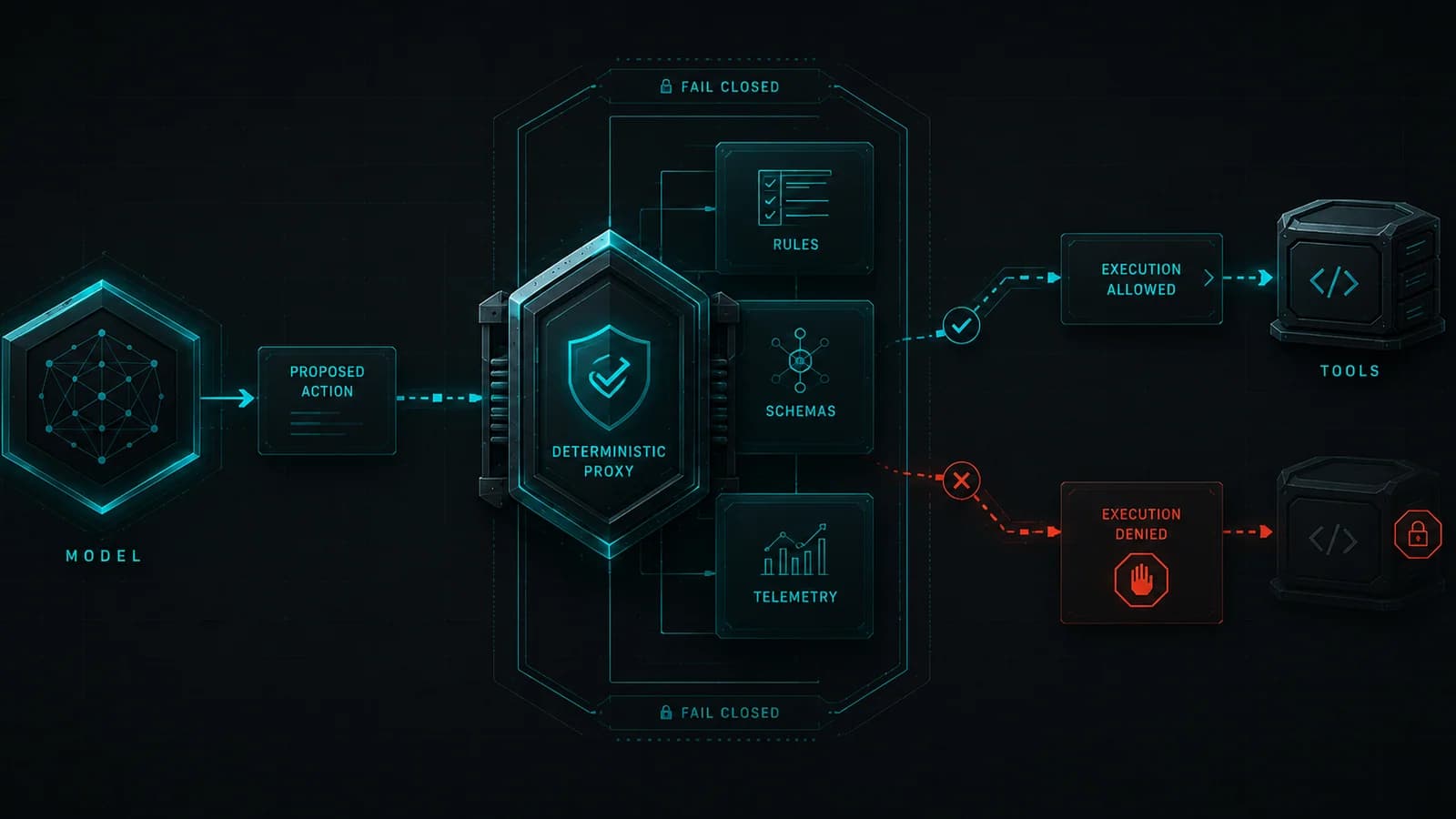
Why deterministic?
Model prompts are not control planes. The proxy enforces guardrails the model cannot negotiate: it evaluates tool-call intents and server metadata against pre-declared policy, independent of model outputs. For production teams, this is the control-plane pattern behind an MCP security proxy and McpVanguard's layered runtime enforcement.
- Enforcement for MCP traffic routed through the boundary
- Fail-closed defaults and minimal implicit trust
- Structured audit events for routed actions
L0 - Preflight
Normalize inputs and inspect metadata before deeper inspection.
L1 - Rules + safe zones
Apply configured deterministic rules to routed tool calls, filesystem boundaries, destinations, and commands.
L1.5 / L2 / L3 - Signals
Use camouflage, semantic, and behavioral signals as advisory context while deterministic policy retains boundary authority.
See it in practice
McpVanguard implements this model for MCP: inspecting routed tool calls, applying configured policy and schema-aware checks, and emitting structured audit events for blocked and allowed routed actions.